Article published by ULCO in the journal ChemCatChem
A scientific article entitled "Mixed Oxides for Simultaneous CO and Toluene Catalytic Oxidation: Effect of Mn/Cu Ratio on Catalytic Performance" was published last April by our partner ULCO in the journal ChemCatChem.
Abstract
Manganese-copper (Mn-Cu) mixed oxides are promising catalysts for abatement of incomplete combustion products from domestic wood burning, notably CO and Volatile Organic Compounds (VOCs). In this paper, the influence of the Mn/Cu molar ratio on structure, redox properties, and catalytic performances was investigated. Mixed oxides were synthesized by oxalate co- precipitation and calcined under air at 500◦C. Physicochemical characterization (XRD, Raman, N2-physisorption, XPS, H2-TPR) revealed strong Mn─Cu interaction. Catalytic tests for total oxidation of CO, toluene, and their mixture showed that copper-rich oxides, especially Cu1 Mn0.25 Ox , achieved the best performance at low temperature (T50 = 49◦C and 230◦C for the oxidation of CO and toluene respectively). In alternating feeding, the presence of CO promotes the oxidation of toluene at low temperature, while an excess of Cu in the material ensures full CO2 selectivity. For mixed oxides, the linear correlation between Cu2+→Cu+ reducibility and T50 for toluene oxidation in presence of CO demonstrates that the incorporation of Mn into Cu oxides enhances oxidation. Overall, tuning the Mn/Cu ratio enables efficient, selective, and simultaneous removal of CO and VOCs, providing a cost-effective solution for emission control from biomass combustion.
Are you scientists? I’d encourage you to read the article 👉 https://chemistry-europe.onlinelibrary.wiley.com/doi/10.1002/cctc.202501805
Here is a brief overview of its content for non-scientists.
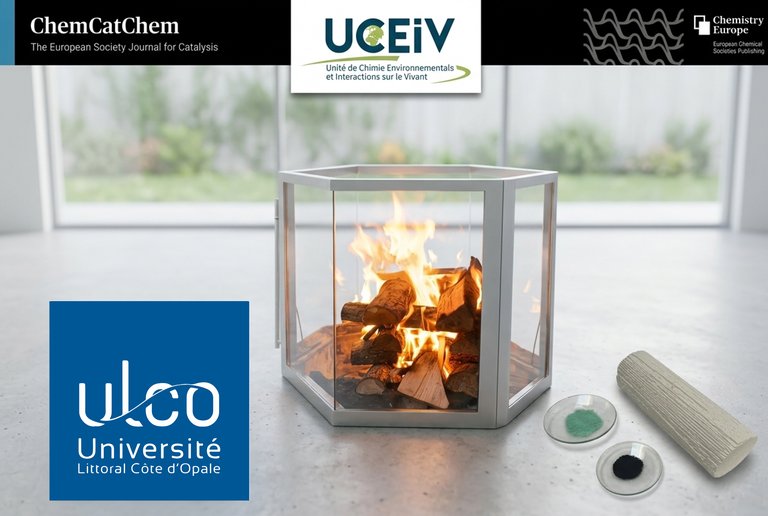
Researchers are studying materials (mixed oxides) based on copper (Cu) and manganese (Mn) to reduce pollution caused by wood burning. These materials can help remove carbon monoxide (CO) and certain volatile organic compounds (VOCs) present in flue gases. They tested different proportions of copper and manganese to find the most effective combination. The results show that copper plays a particularly important role in removing pollutants at low temperatures. The most effective material removes CO from around 49 °C and a VOC such as toluene at around 230 °C. The presence of CO can even facilitate the breakdown of toluene at low temperatures. Adding manganese to copper also enhances the reactions that convert pollutants into less harmful substances. These materials could therefore help to simultaneously reduce CO and VOC emissions from wood-burning heating systems, whilst remaining relatively inexpensive.