
Article publié par UGent et ULille dans "Journal of Environmental Chemical Engineering"
Un article scientifique intitulé : « Post-plasma catalysis for toluene abatement using Mn, Cu, and MnCu oxide on a hydroxyapatite support » issu d’une collaboration entre les deux partenaires UGent et ULille a été publié le 11 mars 2026 dans le Journal of Environmental Chemical Engineering.
Abstract
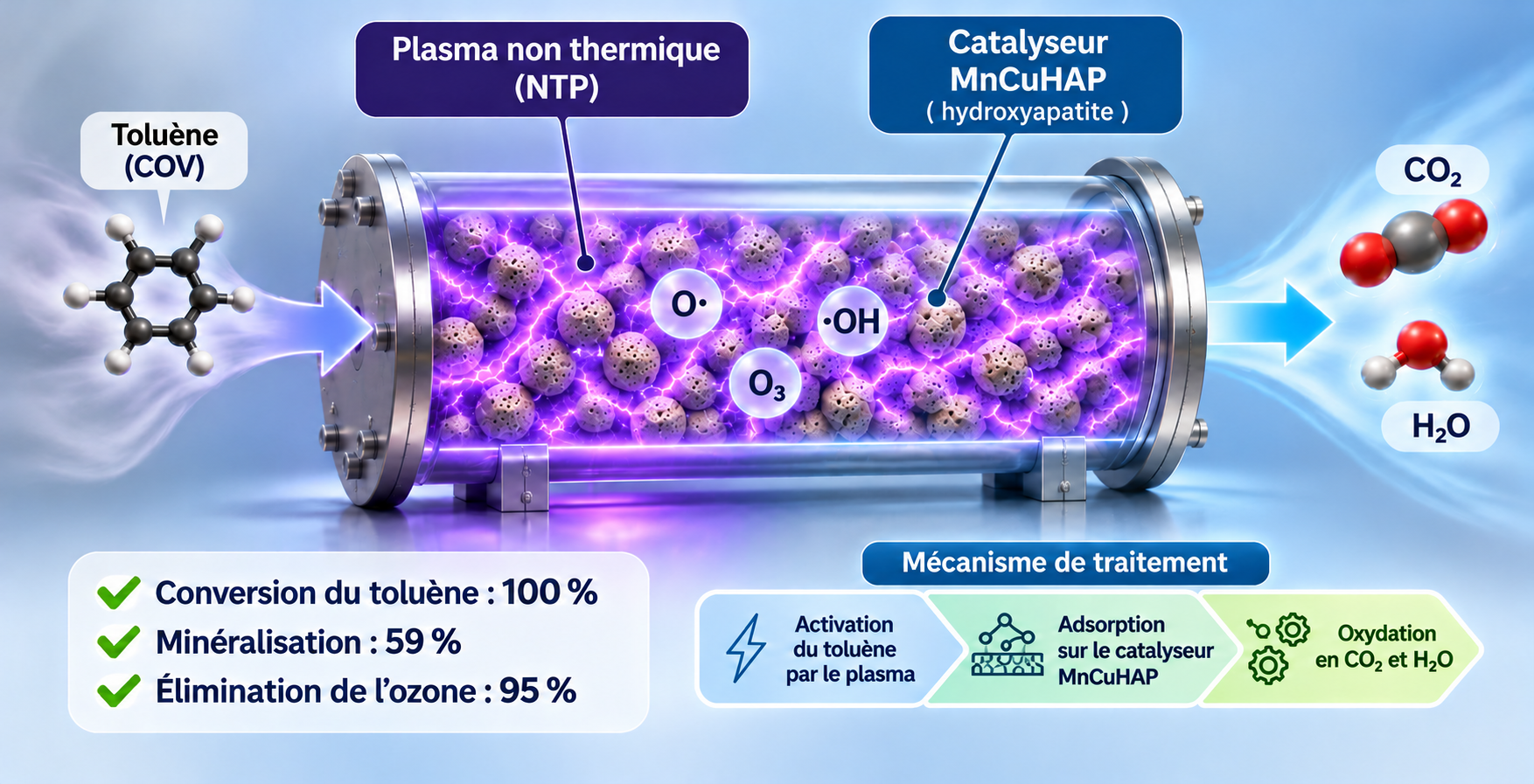
Volatile organic compounds (VOCs) such as toluene are major atmospheric pollutants with significant health and environmental impacts. This study investigates toluene abatement in dry air by post-plasma catalysis (PPC) using Cu, Mn, and Cu-Mn mixed oxides supported on hydroxyapatite (Hap) at catalyst bed temperatures of 100–200 ◦C. The catalysts were prepared by wet impregnation and tested in a non-thermal plasma (NTP) reactor, where toluene (150 ppmv) was introduced into air. The NTP provided preliminary toluene activation and oxidative species to enhance catalytic oxidation. During catalytic oxidation, all samples showed no catalytic activity. In contrast, plasma alone enabled significant toluene conversion (55%) and mineralization (12%). Plasma combined with Hap exhibited strong synergy, boosting conversion and mineralization to 80% and 46% (CO2/CO = 1.4) at 200 ◦C and 350 J L-1. This demonstrated the intrinsic catalytic role of Hap and provided a baseline for assessing the effect of metal impregnation. Metal loading further enhanced PPC performance. The best results were obtained at 100 ◦C, with 2.5 wt% metal loading. The performance trends indicate that Cu-containing catalysts mainly enhance toluene adsorption/activation, whereas MnOx promotes oxidation/by-product conversion and strongly suppresses O3 slip, consistent with redox-active Mn species. The optimal MnCuHap (Mn:Cu = 1:2) catalyst achieved 100% toluene conversion, 59% mineralization (CO2/CO = 1.9), and 95% ozone removal at 350 J L-1. The synergy between NTP and the MnCuHap catalyst highlights the potential of this configuration for efficient VOC abatement and provides a benchmark for future PPC studies.
Vous êtes scientifiques ? Je vous invite à aller lire l’article 👉 https://www.sciencedirect.com/science/article/abs/pii/S2213343726011474
Voici une brève présentation de son contenu pour les non scientifiques.
Cette étude explore une nouvelle méthode pour éliminer le toluène, un composé organique volatil (COV) nocif présent dans l’air, en combinant plasma froid et catalyse. Les chercheurs ont testé différents catalyseurs à base de cuivre et de manganèse, déposés sur un support minéral appelé hydroxyapatite. Les résultats montrent que l’association du plasma et du catalyseur améliore fortement la dégradation du polluant, alors que les catalyseurs seuls sont inefficaces. Le meilleur résultat est obtenu avec un mélange cuivre-manganèse (MnCuHap), qui permet d’éliminer 100 % du toluène et de réduire de 95 % l’ozone produit lors du traitement. Cette combinaison favorise également la transformation du toluène en CO₂, limitant ainsi la formation de sous-produits indésirables. Cette technologie présente donc un potentiel intéressant pour le traitement de l’air et l’élimination des COV.