
Article publié par Materia Nova dans la revue Chemosensors
Un article scientifique intitulé : « Green Synthesis of ZnO Nanoparticles Using Retama raetam Leaf Extract for VOC Sensing Applications » a été publié le 4 février dernier par notre partenaire Materia Nova (Driss Lahem) dans la revue Chemosensors.
Abstract
 The green synthesis of zinc oxide nanoparticles (ZnO NPs) using Retama raetam leaf extract via microwave irradiation was investigated. The biosynthesized NPs were characterized using scanning electron microscopy (SEM), energy dispersive X-ray spectroscopy (EDS), X-ray diffraction (XRD), Fourier transform infrared spectroscopy (FTIR), and UV-Vis spectrophotometry. An XRD pattern confirmed the formation of a hexagonal wurtzite structure. An FTIR analysis indicated the interactions of the NPs with bioactive molecules involved in their synthesis. SEM and STEM imaging determined the morphology of the NPs with an average size of 14 nm. Furthermore, the biosynthesized ZnO NPs were used as a sensitivelayer for detecting volatile organic compounds (VOCs) at low concentrations ranging from 0.5 to 5 ppm. The response sensor measured at an optimum operating temperature of 250 ◦C and 50% relative humidity (RH). The sensor exhibited a strong response to 5 ppm ethanol (325%), a detection limit as low as 4 ppb and an excellent stability across varying humidity levels.
Vous êtes scientifiques ? Je vous invite à aller lire l’article 👉 : https://www.mdpi.com/2227-9040/14/2/42
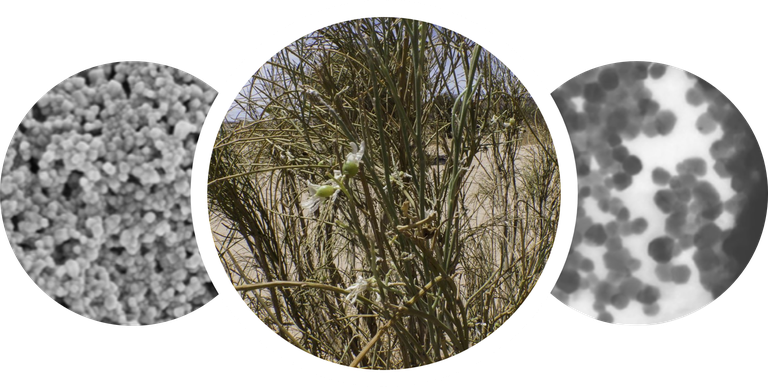
Voici une brève présentation de son contenu pour les non scientifiques.
De l’oxyde de zinc (ZnO) a été obtenu à partir d’extraits de feuilles de Retama raetam grâce à une méthode « verte » utilisant des substances naturelles et un procédé rapide par micro-ondes. Le matériau obtenu a été utilisé pour fabriquer un capteur capable de détecter de très faibles quantités de composés organiques volatils (COV), comme l’éthanol. Le capteur fonctionne de manière optimale à 250 °C et reste stable malgré les variations d’humidité.
Ces résultats montrent son potentiel pour le développement de capteurs sensibles destinés à la surveillance de la qualité de l’air.