Artikel gepubliceerd door UGent en ULille in het tijdschrift "Journal of Environmental Chemical Engineering”
Een wetenschappelijk artikel met de titel: « Post-plasma catalysis for toluene abatement using Mn, Cu, and MnCu oxide on a hydroxyapatite support », dat voortkomt uit een samenwerking tussen de twee partners UGent en ULille, is op 11 maart 2026 gepubliceerd in het Journal of Environmental Chemical Engineering.
Abstract
Volatile organic compounds (VOCs) such as toluene are major atmospheric pollutants with significant health and environmental impacts. This study investigates toluene abatement in dry air by post-plasma catalysis (PPC) using Cu, Mn, and Cu-Mn mixed oxides supported on hydroxyapatite (Hap) at catalyst bed temperatures of 100–200 ◦C. The catalysts were prepared by wet impregnation and tested in a non-thermal plasma (NTP) reactor, where toluene (150 ppmv) was introduced into air. The NTP provided preliminary toluene activation and oxidative species to enhance catalytic oxidation. During catalytic oxidation, all samples showed no catalytic activity. In contrast, plasma alone enabled significant toluene conversion (55%) and mineralization (12%). Plasma combined with Hap exhibited strong synergy, boosting conversion and mineralization to 80% and 46% (CO2/CO = 1.4) at 200 ◦C and 350 J L-1. This demonstrated the intrinsic catalytic role of Hap and provided a baseline for assessing the effect of metal impregnation. Metal loading further enhanced PPC performance. The best results were obtained at 100 ◦C, with 2.5 wt% metal loading. The performance trends indicate that Cu-containing catalysts mainly enhance toluene adsorption/activation, whereas MnOx promotes oxidation/by-product conversion and strongly suppresses O3 slip, consistent with redox-active Mn species. The optimal MnCuHap (Mn:Cu = 1:2) catalyst achieved 100% toluene conversion, 59% mineralization (CO2/CO = 1.9), and 95% ozone removal at 350 J L-1. The synergy between NTP and the MnCuHap catalyst highlights the potential of this configuration for efficient VOC abatement and provides a benchmark for future PPC studies.
Zijn jullie wetenschappers? Ik raad jullie aan het artikel te lezen 👉 https://www.sciencedirect.com/science/article/abs/pii/S2213343726011474
Hier volgt een korte toelichting op de inhoud voor niet-wetenschappers.
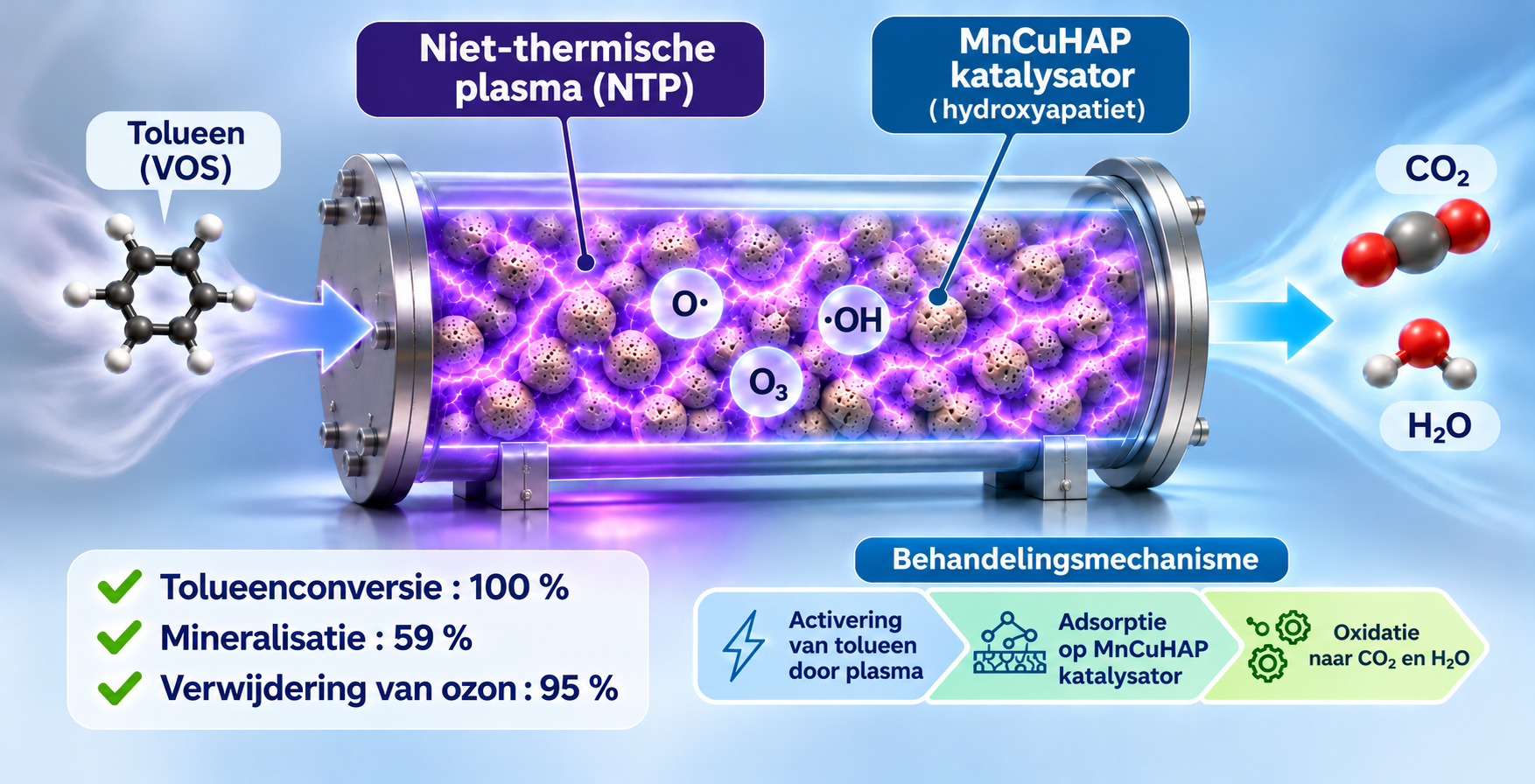
Deze studie onderzoekt een nieuwe methode om tolueen, een schadelijke vluchtige organische stof (VOS) in de lucht, te verwijderen door koude plasma en katalyse te combineren. De onderzoekers hebben verschillende katalysatoren op basis van koper en mangaan getest, die op een minerale drager, hydroxyapatiet genaamd, waren aangebracht. Uit de resultaten blijkt dat de combinatie van plasma en de katalysator de afbraak van de verontreinigende stof aanzienlijk verbetert, terwijl de katalysatoren op zichzelf niet effectief zijn. Het beste resultaat wordt behaald met een koper-mangaanmengsel (MnCuHap), waarmee 100 % van het tolueen wordt verwijderd en de tijdens de behandeling geproduceerde ozon met 95 % wordt verminderd. Deze combinatie bevordert ook de omzetting van tolueen in CO₂, waardoor de vorming van ongewenste bijproducten wordt beperkt. Deze technologie biedt dus interessante mogelijkheden voor luchtbehandeling en de verwijdering van VOS.